From the 1st January 2026, all drones placed on the UK market will use the UK class-marking system (UK0 to UK6). The current EU C-class marks will still be recognised under the equivalent UK-class mark until 31st December 2027, after which it will be fully replaced by the UK version. E.g a C0 class drone will come under the same rules and regulations as if it were a UK0 class drone, C1 as UK1, all the way through to C6 as UK6.
|
DJI Drones* |
EU C-Class |
Recognised as during transition until 31st December 2027 |
|
DJI Neo 2, DJI Neo DJI Mini 3, DJI Mini 2 SE |
C0 |
UK0 |
|
DJI Air 3S, DJI Air 2S DJI Air 3 DJI Avata 2 |
C1 |
UK1 |
|
DJI Mavic 4 Pro, DJI Mavic 3 Pro, Cine DJI Mavic 3E EU/ DJI Mavic 3T EU/ DJI Mavic 3M EU DJI Matrice M30/30T DJI Mavic 4E, 4T DJI Matrice 4D, TD (Also C6) |
C2 |
UK2 |
|
DJI Inspire 3 DJI Matrice 400 |
C3 |
UK3 |
*The latest list of DJI drones with EU class marks can be found here.
|
UK Class Mark/EU equivalent |
Open Category Sub-categories |
|
UK0, UK1 |
Open Over People (A1) |
|
UK0, UK1, UK2 |
Open Near People (A2, certification needed) |
|
UK0, UK1, UK2, UK3, UK4 |
Open Far From People (A3) |
Key highlights can be found in the following areas:
- Appearance
- Registration
- Updated sub-categories in the Open Category
- Pilot qualification in the Open Category
- A2 Certificate of Competency (A2 CofC) holders
- Where you can fly
- Flying at night
- Insurance
Appearance
Drones placed on the UK market from 1 January 2026, will bear the new UK class marks.
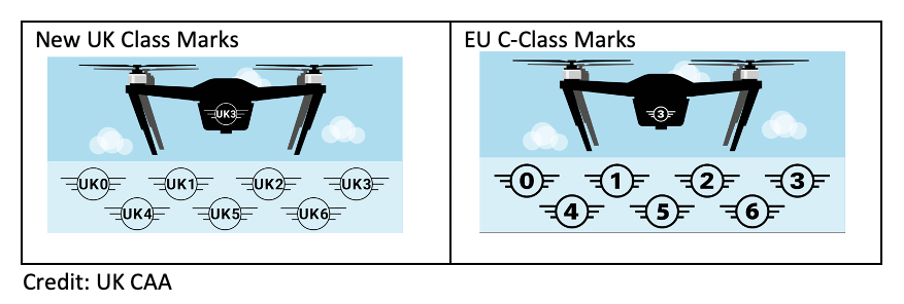
Since the current EU C-class markings will continue to be recognised under the equivalent UK-class markings, operators of DJI drones that bear EASA class markings can continue to operate in the UK without any additional actions required on the drones.
DJI products without an EASA class marking (‘legacy products’), can continue to be used by following the regulations in the UK classes, based on their weight.
Official information from the UK CAA can be found here.
Registration
The weight threshold for mandatory registration and Flyer/Operator ID drops from 250g to 100g:
- Flyer ID: Required for any drone ≥ 100g
- Operator ID: Required for drones with a camera ≥ 100g, or any drone ≥ 250g
Official information from the UK CAA can be found here
Updated sub-categories in the Open Category
The Open Category is structured into:
- A1 – Over People
- A2 – Near People
- A3 – Far from People
Official information from the UK CAA can be found here and here
Pilot qualification in the Open Category
To operate in the Near People (A2) sub-category, you will need to obtain the A2 Certificate of Competency (A2 CofC).
A2 Certificate of Competency (A2 CofC) holders
A2 CofC holders can fly UK2-marked drones (or EU C2 drones until 31 December 2027) weighing up to 4 kg and with feature enhanced safety systems to:-
- reduce the horizontal separation in normal mode down to 30-meters.
- enable a 5-meters horizontal separation in low-speed mode
Official information on A2 CofC can be found here.
Where you can fly
- Pilots must always keep the geo-awareness system up to date.
- Pilots need to download the UAS geographical zones file developed and published by NATS and upload it to the DJI Apps.
General rules from the UK CAA about where you can fly can be found here.
The UAS Restrictions Map by NATS can be found here.
Flying at night
Night operations require a flashing green light visible to others.
Official information from the UK CAA can be found here
Insurance
If you fly for recreation or sport, you can choose whether to have insurance.
If you fly commercially, you must have third party insurance.
Official information from the UK CAA can be found here
Please always refer to UK CAA’s official website for the latest, up to date official information: https://www.caa.co.uk/drones/